'PR Moves at the Speed Of Emotion’ – Why Fame is being rewritten in Culture
Fame is changing.
And according to Louise Ali, Digital PR Business Director at PrettyGreen, brands that don’t adapt to that shift risk becoming background noise.
In a climate defined by economic uncertainty, cultural volatility and low consumer trust, Louise explains why PR has moved from a supporting channel to the engine of modern brand fame, and why the brands winning today are the ones that know how to feel culture, not just buy into it. We sat down with Louise to talk about trust, attention, cultural moments and why PR is uniquely placed to turn relevance into commercial growth.
Q: Louise, what does the current state of consumer confidence mean for brands right now?
Louise Ali: Consumer confidence is at an all-time low since we’re living through a period of constant pressure, cost of living, inflation, political uncertainty, global crises. People are sceptical, fatigued, and far less receptive to being sold to.
Consumers don’t want brands talking at them anymore. They want brands to understand them, to reflect the reality they’re living in, and to genuinely help. That’s where PR comes into its own, because PR is built on empathy, relevance and trust, not interruption.
When confidence is low, brands can’t rely on volume or visibility alone. They have to earn attention. And PR is fundamentally designed to do exactly that.
Q: You often say that culture isn’t captured by being seen, but by being felt. What do you mean by that?
Louise: Every channel plays a role in culture, paid media, social, experiential, influencer, all of it matters. But to truly capture culture, you need more than exposure. You need emotional connection.
Culture moves fast. It’s reactive, emotional, sometimes messy. It’s shaped by humour, outrage, empathy, curiosity; real human responses. PR can move at the same speed people feel things.
While other channels are planning how to enter a conversation, PR is already there, shaping it in real time, influencing how people understand what’s happening and how they feel about it. That’s the difference. Culture isn’t something you schedule. It’s something you respond to or spark
Q: In uncertain times, many brands shift budget toward performance or product-led advertising. Is that a mistake?
Louise: It’s an understandable instinct — but often the wrong one.
When trust is low, brand matters more, not less. And brand is built through meaning, not just messaging. PR builds trust because it earns attention instead of buying it.
Yes, scale matters. But during peak cultural moments e.g. the World Cup, a Stranger Things finale, a Bond movie — every brand, every channel, every budget floods the space. Paid attention can start to feel cheap or forced. Earned attention, on the other hand, becomes incredibly powerful.
PR doesn’t win by shouting louder. It wins by adding something worth saying to conversations people are already having.
Q: Can you give an example of what that looks like in practice?
Louise: A great example is when Oasis made their comeback. Rather than forcing a brand into the moment, Lidl created the Lidl by Lidl jacket, a playful, emotionally intelligent response that people genuinely wanted to talk about and share.
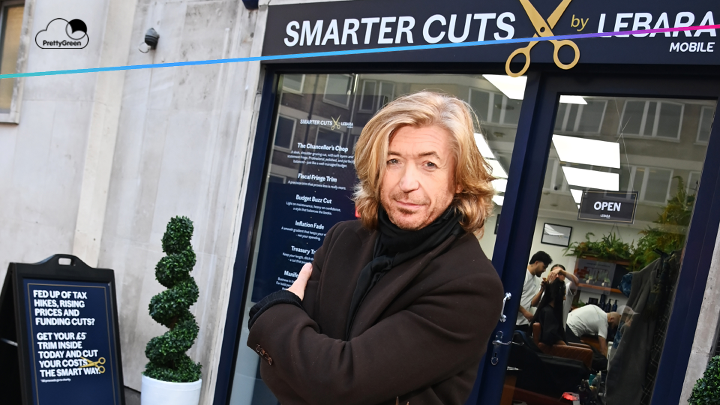
Or when the national mood was low following government budget cuts, we partnered with Lebara to launch the Smarter Cuts pop-up hair salon with Nicky Clarke. It tapped directly into cost-of-living conversations while staying completely true to the brand.
Those campaigns didn’t work because of where they appeared. They worked because they were stories worth telling.
Q: There’s still a perception that PR is hard to measure. How do you respond to that?
Louise: Honestly, that perception is outdated.
PR is more powerful and more measurable than it’s ever been. Today, PR directly influences search behaviour, brand discovery, and even how brands show up in AI-generated responses.
We’re culturally fluent and creative, but we’re also delivering measurable impact at pace — often without the eye-watering budgets that come with other channels. That’s a big part of modern fame: visibility that converts into memory, trust and commercial growth.
Q: You’ve spoken before about PR’s role in humanising big issues. Why is that so important?
Louise: Because people don’t connect with abstractions — they connect with stories.
PR helps brands take big complex issues, climate change, cost of living, parenthood and turn them into moments people recognise themselves in. That’s how memory structures are built: not through repetition or exposure, but through emotion.
A perfect example is our Peppa Pig campaign. When Mummy Pig’s pregnancy was announced, it mirrored real family experiences, sharing the first scan, pregnancy photoshoots, even a full-scale gender reveal moment at Battersea Power Station.
It stopped being a storyline in a children’s cartoon and became a national cultural moment. 81% of parents named the Peppa Pig family as cultural icons, and other brands from Lego to John Lewis to Burger King, organically joined the conversation.
That didn’t happen because of reach. It happened because of resonance
Q: So is PR still a reactive channel — or something more?
Louise: PR isn’t just reactive. We don’t only chase culture — we create it.
PR moves at the speed of emotion.
PR earns attention instead of buying it.
PR turns moments into human stories.
And sometimes, PR doesn’t just capture culture, it sparks it.
Every channel is great at amplifying culture. But without a story people genuinely care about, there’s nothing to amplify. That’s why PR sits at the heart of modern fame and why brands that understand this grow faster, stay relevant longer, and perform better commercially.